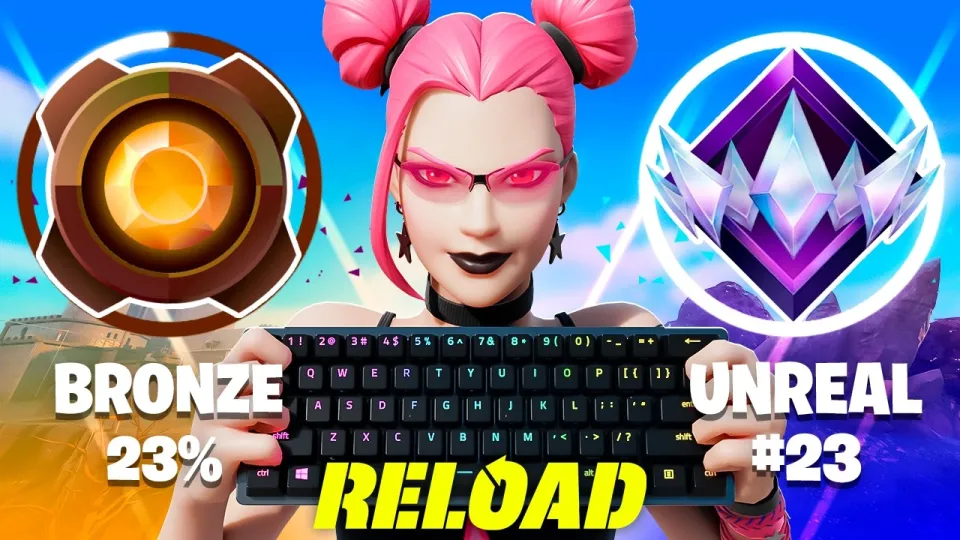
How HaloBT Took a Bronze to Unreal Fortnite Ranked Speedrun Through Fortnite Reload
You can order the same kind of articles for your own video to boost it on YouTube and Google. Just message the Telegram bot @sat_sit_bot. The bot writes and publishes the articles itself (with your YouTube video embedded) on popular topical websites (no ads). Try it free: 50 articles on us.
· based on the channel HaloBT
Key takeaways
- The run starts at Bronze and ends at Unreal entirely inside Fortnite Reload, the faster respawn-based ranked mode.
- Reload ranked uses the standard ladder: Bronze, Silver, Gold, Platinum, Diamond, Elite, Champion and Unreal.
- Gold is the recurring choke point in the climb because elimination points and placement points start to diverge.
- HaloBT's practice map Elite Aim Edit Piece is published under code 6317-4546-8691 and searchable as "halobt".
- All creator maps and updates are listed at https://www.fortnite.com/@MoreHaloBT.
A Bronze to Unreal Fortnite ranked speedrun in Fortnite Reload is a single continuous climb through every tier of the ranked ladder, from the lowest Bronze division up to Unreal, played in Reload rather than standard Battle Royale. The goal is not a high kill record but the shortest possible number of matches between two fixed rank checkpoints, which makes placement consistency and early-game survival more valuable than highlight plays. HaloBT's run of this format is the reference point for anyone planning the same grind, and the creator's map hub at MoreHaloBT on fortnite.com is where the practice builds and updates live.
What the Fortnite Reload ranked ladder actually requires
Fortnite Reload ranked runs on the same eight-tier structure as the main ranked playlist, so the speedrun has to clear Bronze, Silver, Gold, Platinum, Diamond, Elite and Champion before Unreal unlocks. Each tier is split into divisions, and progress is earned from two sources: placement in the final standings and eliminations. Reload shortens the loop because dying is not the end of the match — respawns keep squads alive longer, which raises the number of fights per game and, in theory, the number of elimination points available.
The catch is that Reload's respawn economy also raises the average skill floor of a lobby. Opponents who would be eliminated early in standard Battle Royale get second and third chances, so a Bronze player climbing quickly has to win repeated fights against the same team rather than one clean wipe. A speedrun therefore depends on two habits: taking fights only when the squad has numbers, and closing out the final zone instead of chasing extra kills after the placement points are already secured.
Why Gold is the hardest wall in a Bronze to Unreal climb
Gold is the tier where the points curve stops rewarding survival alone and starts demanding eliminations, which is why so many Unranked to Unreal attempts stall there. In Bronze and Silver, a patient player can climb on placement points with modest fighting; by Gold, the placement payout flattens and the difference between a top-five finish and a win no longer covers the gap on its own. Players who reach Gold with weak mechanics hit a ceiling almost immediately.
A practical way through the wall, based on how the ladder behaves:
- Treat the first two fights of every match as mandatory practice — land contested, take the 50/50, and learn the timing rather than avoiding it.
- Stop chasing eliminations after the squad has secured a top-five position; the marginal points are not worth the risk of a full team wipe.
- Review each loss for the single decision that cost the placement, not for aim.
- Queue with the same duo or squad where possible, because Reload rewards coordinated respawn pushes far more than solo improvisation.
The same pattern repeats at Diamond, but for a different reason: opponents there punish slow rotations, so the fix is pace rather than aggression.
Solo queue, duo fills and the teammates problem
Solo queueing a ranked speedrun is the hardest version of the challenge because Reload's respawn mechanic makes a weak teammate a repeated liability rather than a one-time loss. A fill player who pushes alone feeds eliminations to the opposing squad, and because that squad can respawn, the mistake compounds across the match. Duo fills reduce the randomness slightly — one reliable partner covers rotations and revives — but the ranking climb still depends on how quickly the pair adapts to a third and fourth player who may not communicate.
The realistic advice for anyone copying the format is to accept that a portion of matches are unwinnable and to protect the rank floor instead of forcing points. Speedruns look like a straight line in a highlight video; in practice they are a long series of small point gains with occasional resets, and the players who finish fastest are the ones who stop tilt-queueing after two bad games.
Mechanics you need before starting the climb
A Bronze to Unreal speedrun is a mechanics test disguised as a ranking test, and the skills that matter most in Reload are not the flashiest ones. Editing speed through windows and cones, consistent shotgun-to-SMG swaps, and box fighting at close range decide most Reload engagements because respawned players re-enter fights from predictable angles. Build fights matter less than reset speed: the player who can disengage, heal and re-engage in a few seconds wins more matches than the one who builds a tower.
HaloBT maintains a dedicated training build for exactly this, the Elite Aim Edit Piece map, published under code 6317-4546-8691 and searchable in-game as "halobt". The map is designed for repeatable aim and edit reps rather than free building, which matches the skills that actually convert into ranked points. Players who grind a routine there before queueing tend to see the biggest gains in Gold and Platinum, where the points curve is least forgiving.
Controller, KBM and the input debate around ranked climbs
Input choice changes the shape of a speedrun more than it changes the ceiling. Controller players get aim assist in close-range fights, which suits Reload's constant respawn brawls; keyboard and mouse players get faster edits and more precise tracking at mid range but need far more mechanical practice to match the consistency of a controller in a box fight. Neither input removes the Gold wall — the tier is about decision-making, not hardware.
The more useful distinction is between players who practice deliberately and players who simply queue. A controller player who runs aim and edit drills for ten minutes before a session will climb faster than a KBM player who jumps straight into ranked, and the reverse is also true. The input matters at the margin; the routine decides the pace.
Common questions from players attempting the same run
Most questions about this format come down to improvement plateaus and rank anxiety. Players who switch input or start training report fast early gains that flatten after a few weeks, and the usual cause is practising the same drills at the same difficulty instead of targeting the specific situations that cost them matches. The fix is to log losses by category — rotation, aim, build, decision — and drill only the category that appears most often.
A second recurring theme is confidence. Reaching a high rank once, even briefly, changes how a player approaches fights, and several players describe the mental shift as the real turning point rather than any mechanical breakthrough. That is consistent with how the ranked ladder is built: it rewards repeated, low-risk decisions far more than single spectacular games.
Useful links
- Creator map hub and Fortnite updates: https://www.fortnite.com/@MoreHaloBT
- Community Discord: https://discord.com/invite/halobt
- Live streams: https://www.twitch.tv/halobt
- Twitter: https://twitter.com/halobombtrooper
- Instagram: https://www.instagram.com/therealhalobt
Final thoughts on the Fortnite ranked speedrun format
A Bronze to Unreal run in Fortnite Reload is a test of consistency rather than a highlight reel, and the fastest climbs come from protecting placement points and drilling the mechanics that decide close fights. Gold remains the decisive tier for most players, and the difference between finishing the run and stalling there is usually a routine, not a rank. HaloBT's channel is the source for this format, with the full speedrun and the practice map that supports it. If you want the training build and the latest map updates first, start at the MoreHaloBT Fortnite hub and subscribe to the channel for the next attempt.
Questions & answers
How long does a Bronze to Unreal speedrun take in Fortnite Reload?
There is no fixed match count, because points per game vary with placement and eliminations. A clean run with consistent top-five finishes moves several divisions per session, while a run that stalls in Gold can take far longer. The tier, not the clock, is the real measure of progress.
Is it easier to reach Unreal in Reload or in standard Battle Royale?
Reload offers more fights per match thanks to respawns, which means more elimination points available, but the lobbies are also tougher on average because players get second chances. Standard Battle Royale rewards survival more directly. Most players find Reload faster to climb only if their fighting is already strong.
Do I need a squad to finish an Unranked to Unreal climb?
No, but solo queueing is the hardest version. Duo fills cut the randomness of a full random squad, and a consistent partner makes respawn pushes far more reliable. If you queue alone, protect your rank floor and stop after two losses in a row.
What should I practise before starting the ranked climb?
Focus on close-range box fighting, fast edits through windows and cones, and weapon swaps rather than free building. A repeatable aim and edit routine, such as HaloBT's Elite Aim Edit Piece map under code 6317-4546-8691, gives measurable reps that translate into ranked points in Gold and Platinum.
Source: BRONZE To UNREAL Ranked Speedrun In Fortnite Reload! · Markdown version